Alibaba Wukong Brings AI Agents to Enterprise Work
Alibaba's Wukong platform coordinates multiple AI agents for complex business workflows. Available in closed beta via DingTalk and a desktop app, powered by Qwen.
Most enterprise AI is still assistant-first: a human asks, the AI responds, the human decides what to do with it. Wukong is built around a different assumption.
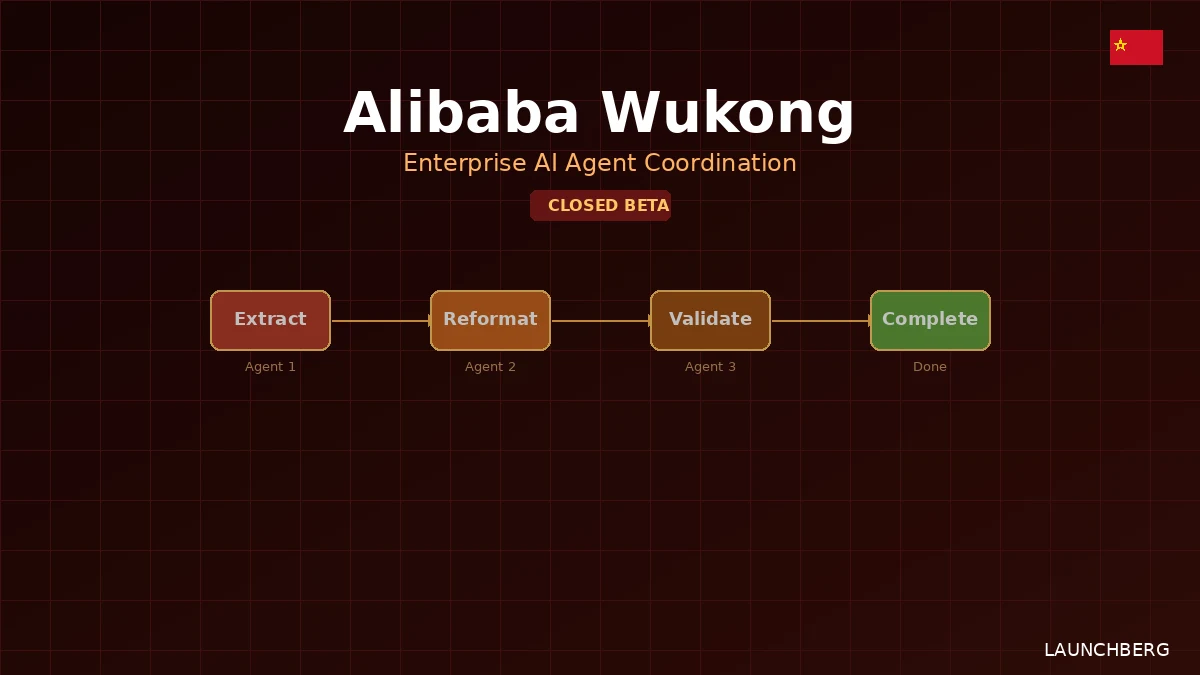
Alibaba launched Wukong today in closed beta — an enterprise platform that coordinates multiple AI agents to complete complex, multi-step business workflows autonomously. One agent extracts data, another reformats it, a third validates against compliance rules. The platform manages those dependencies without requiring a human to hand off between each step.
What Wukong Can Do
The platform covers ten industry-specific agent bundles Alibaba calls OPT — “One Person Team” — deployable with a single click. The categories: e-commerce operations, cross-border trade, content creation, software development, retail, design, manufacturing, legal services, accounting and tax, and executive recruitment.
In practice, that means a task like “prepare the quarterly vendor report” gets decomposed into discrete agent steps — pulling records, running calculations, formatting output, flagging anomalies — rather than handed to a single model that produces one response. Wukong operates local desktop applications, browsers, and cloud-based systems simultaneously, which means the agents aren’t limited to text generation; they can interact with software the way a human employee would.
It’s available as a standalone desktop application or embedded directly in DingTalk, Alibaba’s workplace collaboration platform that has over 20 million corporate users.
Enterprise-Grade, Not Consumer-Grade
The distinction Alibaba is drawing — explicitly — is that most existing AI agents are “consumer-grade.” Wukong’s positioning as enterprise-grade rests on a few concrete features: permission inheritance (agents automatically respect company access controls rather than requiring separate configuration), real-time token tracking, identity verification, and enterprise sandboxes.
That permission layer matters in regulated industries where the problem isn’t AI capability but AI accountability. An agent that bypasses access controls creates liability regardless of how good its output is.
The platform is powered by Alibaba’s Qwen model, but also supports OpenAI models and other providers via Alibaba Cloud. The architecture is built on Tauri (Rust-based) rather than Electron — a deliberate engineering decision for performance and reduced memory overhead.
Compared to Copilot and Agentforce
Microsoft Copilot for Enterprise keeps humans in the loop throughout — it’s an assistant that handles the high-volume administrative work, not an autonomous executor. Salesforce Agentforce runs autonomously across CRM and ERP workflows, but its strongest vertical is sales and customer service.
Wukong’s differentiation is the multi-agent coordination layer combined with enterprise governance — the combination that neither Western platform has fully shipped. Whether that translates to enterprise adoption outside China is a different question.
The Bigger Strategic Picture
Alibaba announced this alongside a major restructuring: the formation of an “Alibaba Token Hub” business unit that consolidates the Tongyi Lab, its model-as-a-service infrastructure, Qwen, Wukong, and AI Innovation under a single group reporting directly to CEO Eddie Wu. The framing — power generation (Tongyi), transmission (cloud), consumption (Qwen/Wukong) — treats token generation as an infrastructure utility business.
The roadmap for Wukong includes integrations with Slack, Microsoft Teams, WeChat, Taobao, and Alipay. Pricing is token-based rather than fixed monthly fees, which aligns with the utility framing.
The pressure in Chinese enterprise AI is intense right now. Wukong is Alibaba’s answer to that pressure — a platform bet on multi-agent enterprise workflows before the Western players have fully figured out the governance layer.
Closed beta access is by invitation. No public timeline for general availability yet.