Baidu Is Turning Its Smart Devices Into OpenClaw Agents
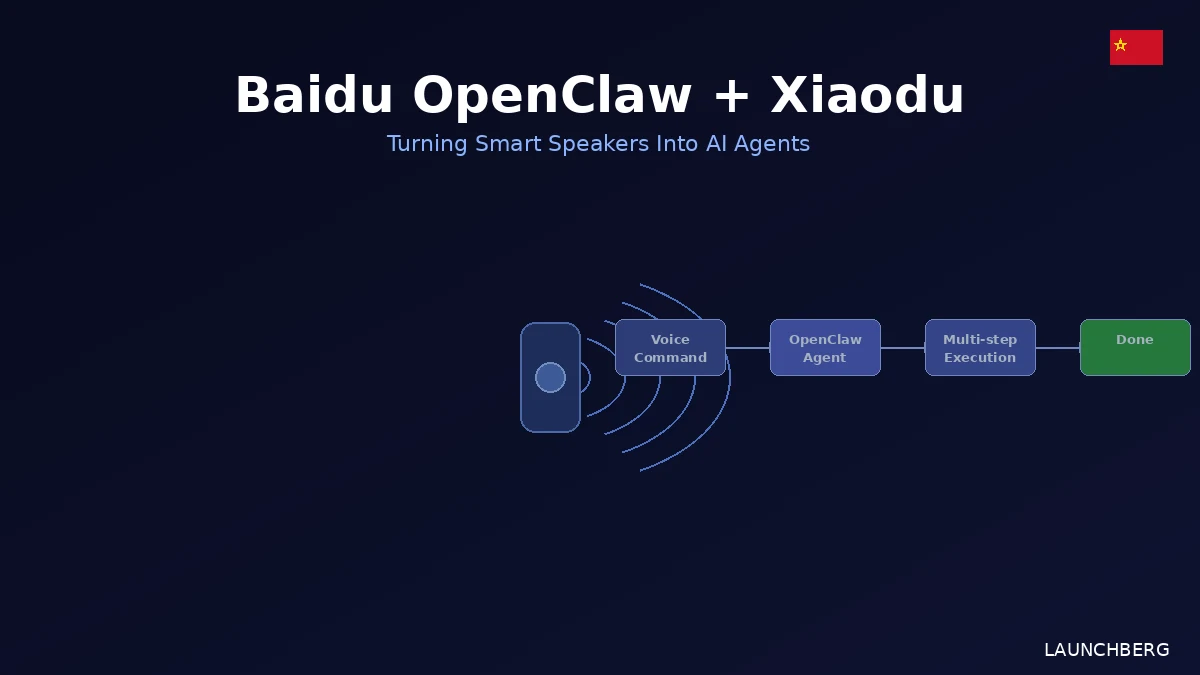
Baidu is integrating OpenClaw's agentic AI framework into Xiaodu smart speakers, moving toward multi-step voice-controlled task execution as its core business erodes.
Baidu’s core search business is under sustained pressure. Alibaba’s Qwen model holds 17.7% of Chinese model invocation share; ByteDance’s Doubao has 155 million weekly active users and 14.1% share. Baidu’s Ernie Bot, which led the market in early 2023, has been losing ground steadily. The company just posted its worst sales decline in two years.
Against that backdrop, the Xiaodu move makes strategic sense. Baidu already has 700 million-plus users across its Xiaodu smart home device ecosystem. Integrating OpenClaw — an open-source agentic AI framework — turns those devices into something more than voice-controlled remotes for lights and timers.
What OpenClaw Is
OpenClaw is an open-source agentic framework that supports complex, multi-step task execution with minimal human input. Rather than a single model responding to a query, it coordinates sub-agents, manages dependencies between steps, runs loops, and handles conditional logic. The kinds of tasks it’s designed for: editing a video, building a presentation, conducting research across multiple sources, ordering food, managing calendar entries.
Baidu’s DuClaw variant is a cloud-deployed version that enables zero-local-deployment agentic services — the device triggers the task, the cloud does the orchestration.
Integrated into Xiaodu, this means a voice command like “order coffee from my usual place and add a calendar event for 30 minutes from now” becomes a single orchestrated task rather than two separate requests — or a task the device couldn’t do at all.
Compared to Alexa and Google Home
Amazon Alexa+ has been trying to add agentic capabilities for over a year with mixed results. The product is strongest for Amazon shopping tasks (250 million Prime members creates natural purchase intent) but has struggled with natural multi-step task understanding beyond its own ecosystem. Google Home benefits from Gemini’s contextual intelligence and cross-service reasoning but has been less aggressive on commerce.
Neither has shipped something as architecturally complete as OpenClaw’s framework — multi-agent coordination with sub-workflows, conditional branching, and loop conditions. That’s a genuine technical edge, though it comes with the rough edges of any agentic system still in deployment. OpenClaw makes mistakes, particularly on longer task chains.
The deeper comparison is strategic: Amazon and Google are extending their existing AI assistant products toward agents. Baidu is running the opposite direction — pivoting a hardware device footprint toward agent-first capabilities as a way out of its core business commoditization.
The Bet
This isn’t a story about Baidu winning the Chinese AI race. Qwen and Doubao have stronger positions in the model layer. What Baidu has is hardware distribution — smart speakers, screens, remote controls in hundreds of millions of homes — and a desperate need to differentiate.
Alibaba’s Wukong is going after enterprise workflows. ByteDance is going after consumer time. Baidu is betting on the smart home as the access point for agentic AI adoption — a space where voice interaction and physical device control give agents a real surface area beyond chat.
Whether OpenClaw’s framework is good enough to make that bet land is still an open question. But the logic of the move is clear: if you can’t win on AI intelligence, win on AI distribution.