Canva Magic Layers Turns Any Flat Image Into an Editable Design
Upload a PNG, get back separated layers with live editable text. Canva's Magic Layers decomposes flat images into full design projects — available now on Free, Pro, and Enterprise.
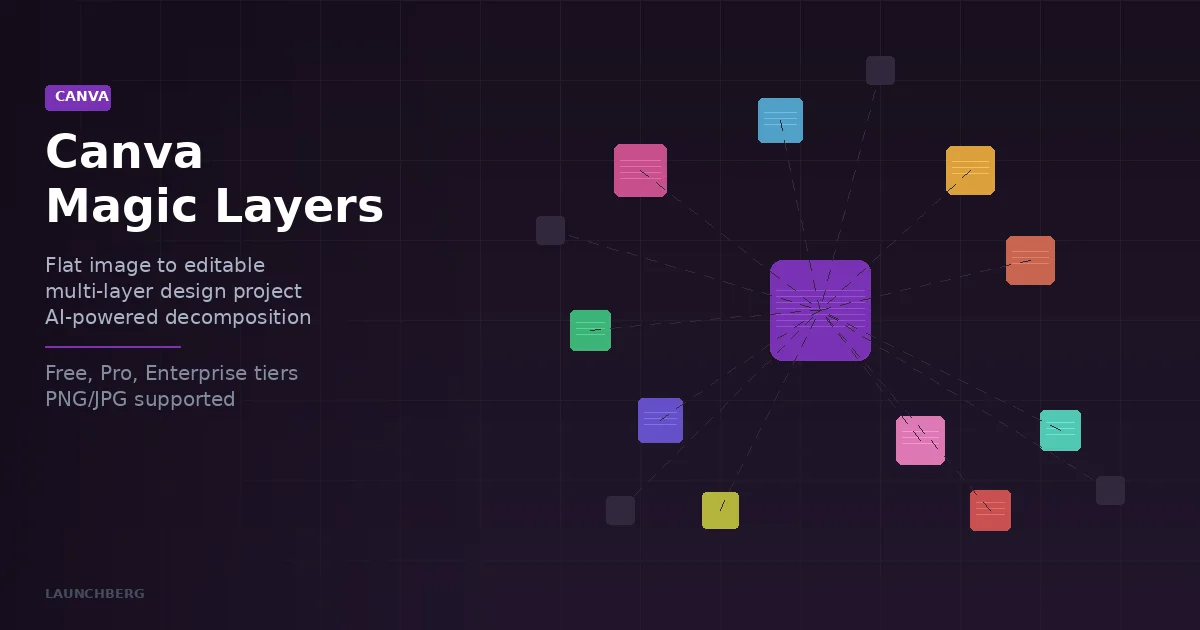
Someone sends you a poster as a flat PNG. No source file. No Canva link. Just pixels. Normally you'd recreate it from scratch or open Photoshop and start cutting. Magic Layers takes that PNG and gives you back a fully editable Canva project — text as live text boxes, objects as separate movable elements, background cleanly isolated behind everything.
It launched March 11 in public beta across the US, UK, Canada, and Australia, with global availability coming. And it works on the free tier.
How It Actually Works
Magic Layers doesn't trace outlines or run edge detection like traditional image separation tools. It analyzes the design's semantic structure — figuring out that this blob of pixels is a headline, that region is a background, those shapes are icons, and that strip at the bottom is a footer. Text gets recognized and restored as actual editable text boxes with correct font sizing, not rasterized shapes that look like text.
The underlying model is Canva's proprietary Design Model, the same foundation model that powers their integrations with ChatGPT, Claude, and Microsoft Copilot. Since launching in October 2025, it's generated hundreds of millions of editable designs. The key word is "editable" — Canva's model was specifically trained to produce outputs with design structure intact, not just pretty pixels. Magic Layers applies that same understanding in reverse: given finished pixels, reconstruct the structure.
Drop in a PNG or JPG. The tool returns a multi-layer Canva project where you can change the headline text, swap the background, recolor individual elements, or adjust spacing — all without touching the original image file again.
What It Handles Well (and What It Doesn't)
Graphic designs, illustrations, social media posts, flyers, and stylized visuals are the sweet spot. These have clear visual hierarchy — distinct text, shapes, and backgrounds — that the model can decompose reliably. AI-generated images from tools like DALL-E or Midjourney also work well, which is a smart product choice since "I generated this cool image but can't edit the text on it" is an increasingly common problem.
Photo-realistic images are harder. A photograph of a street scene doesn't have the same clean semantic structure as a designed poster. Magic Layers will try, but the results won't be as precise. This isn't Photoshop's neural layer separation — it's design decomposition, not photo editing.
Canva vs. Photoshop: Different Problems
Adobe has AI-powered layer tools too, but they solve a different problem. Photoshop's tools focus on pixel-level manipulation — separating a person from a background, adjusting lighting on individual objects, removing elements from photos. It's photo editing.
Magic Layers focuses on design structure. It understands that a poster has a headline, a subheading, a call-to-action button, and a decorative background — and it preserves those relationships. Move the headline and the visual hierarchy still makes sense. Change the background color and the text remains readable. That's a design tool thinking like a designer, not a photo editor thinking about pixels.
For the Canva audience — marketers, social media managers, small business owners — this distinction is everything. They don't need Photoshop's power. They need to take a flat image and change three words on it without hiring a designer.
Pricing
Available across all Canva tiers. Free users get limited AI credits. Pro ($13/month) and Business get 500 monthly AI credits shared across all Magic Studio tools. Enterprise gets unlimited access. Magic Layers uses the same credit pool as Magic Write, Magic Media, and other AI features — there's no separate billing.
For a tool that eliminates the "I don't have the source file" problem, that's essentially free for existing Canva subscribers. The Pro plan was already worth it for most of the 200 million monthly active users before Magic Layers existed.
Why This Matters Beyond Canva
The bigger story is what this means for AI-generated content. Right now, image generators produce final outputs — beautiful but frozen. You can't tweak the text, adjust the layout, or swap one element without regenerating the entire image and hoping the parts you liked survive. Magic Layers breaks that pattern. Generate an image with any model, import it into Canva, decompose it into layers, edit what you want.
It turns every AI image generator into a rough-draft tool rather than a final-output tool. That's a meaningful shift for creative workflows where the first generation is never quite right — which is to say, most of them.
Supported formats are PNG and JPG. Global rollout is planned but no timeline given. If you're in the US, UK, Canada, or Australia with a Canva account, it's live now in the editor.