Nano Banana 2: 4K AI Images Go Mainstream
Google releases Nano Banana 2 — technically Gemini 3.1 Flash Image — bringing 4K resolution, character consistency, and real-time web grounding to AI image generation across the Gemini app, Google Search, and the developer API.
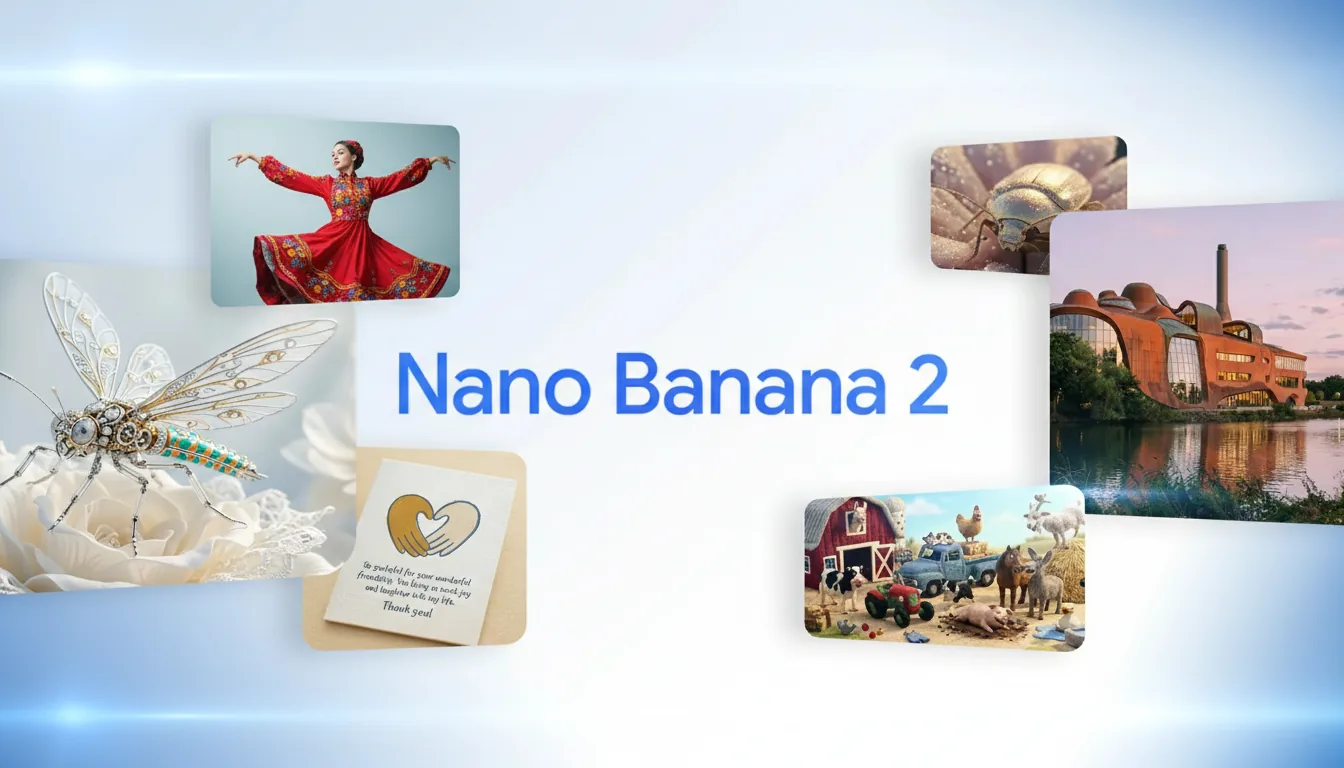
Google has released Nano Banana 2, the successor to its popular AI image generation model that first launched in August 2025. Officially designated as Gemini 3.1 Flash Image, the new model combines the high-fidelity output quality of the earlier Nano Banana Pro with the speed characteristics of Google's Gemini 3.1 Pro family — and it is now the default image generation engine across Google's consumer and developer products.
The release, announced on February 26, 2026, marks a significant step in making production-quality AI image generation accessible at scale, with the model already deployed across the Gemini app, Google Search via Lens and AI Mode in 141 countries, and the developer API.
From Pro Quality to Flash Speed
The original Nano Banana, released in August 2025, established Google's entry into the competitive AI image generation space. Its Pro variant, which followed in November 2025, pushed output quality considerably higher but at the cost of generation speed and computational expense. Nano Banana 2 represents Google's attempt to resolve that trade-off: deliver Pro-level visual fidelity at Flash-tier latency.
According to Google's official announcement, the model achieves this through architectural optimizations in the Gemini 3.1 Flash Image pipeline that reduce the number of inference steps required without proportionally degrading output quality. The result is a model that generates images noticeably faster than Pro while retaining the sharpness, color accuracy, and compositional coherence that made the Pro variant attractive for professional use cases.
4K Resolution and Flexible Outputs
Perhaps the most headline-worthy specification is native 4K resolution output. Nano Banana 2 supports image generation at resolutions ranging from 512 pixels up to full 4K, across ten aspect ratios: 1:1, 2:3, 3:2, 3:4, 4:3, 4:5, 5:4, 9:16, 16:9, and 21:9. This flexibility makes the model practical for a wide range of real-world applications — from vertical social media content to ultrawide banner images — without requiring post-processing upscaling that typically introduces artifacts.
The resolution range is particularly relevant for commercial and creative workflows where output quality directly impacts usability. A 4K image generated natively is fundamentally different from a 1024-pixel image scaled up through super-resolution techniques, and the distinction matters for print production, large-format displays, and any context where pixel-level detail is scrutinized.
Character Consistency and Text Rendering
Two capabilities that have historically challenged AI image generators — character consistency and text rendering — received dedicated attention in Nano Banana 2. The model supports consistency across up to five characters within a single generation or across a series of related images, enabling use cases like storyboarding, character-driven marketing campaigns, and sequential visual narratives where the same figures need to be recognizable across frames.
Text rendering, long the Achilles' heel of diffusion-based image models, has also improved. Google reports that Nano Banana 2 can accurately render text within images with significantly fewer errors than its predecessors — a capability that matters for generating mockups, signage, UI prototypes, and any visual that incorporates readable typography.
The model also introduces what Google calls "14-object fidelity," meaning it can maintain distinct, coherent representations of up to 14 separate objects within a single scene. For complex compositional prompts — think a detailed room interior or a busy street scene — this represents a meaningful improvement in the model's ability to follow instructions faithfully.
Real-Time Web Grounding
One of the more technically interesting additions is real-time web search grounding. When generating images based on prompts that reference current events, real-world locations, or specific products, Nano Banana 2 can pull contextual information from live search data to improve the factual accuracy of its output. Google describes this as reducing the "hallucination gap" between what users expect from a prompt referencing something real and what the model actually produces.
This capability is particularly relevant for Google Search integration, where Nano Banana 2 now powers image results surfaced through Google Lens and AI Mode. When a user's search implies a visual result — say, a query about a recently released product — the model can generate contextually appropriate images grounded in actual web data rather than relying solely on its training distribution.
Developer Access and Safety Measures
For developers, Nano Banana 2 is available in preview through the Gemini API, the Gemini CLI, and the Vertex AI platform, alongside other multimodal features like NotebookLM cinematic video overviews. Google has published developer documentation covering the model's capabilities, rate limits, and integration patterns.
On the safety front, all images generated by Nano Banana 2 carry a SynthID watermark — Google's steganographic marking system for identifying AI-generated content. The watermark is embedded at the pixel level and is designed to survive common image transformations like cropping, compression, and resizing, though its robustness against adversarial removal remains an active area of research.
Where Nano Banana 2 Fits
The AI image generation landscape has grown increasingly competitive over the past year, with significant entries from OpenAI (DALL-E 4), Midjourney (v7), Stability AI, and a proliferation of open-source alternatives built on Flux and SD3 architectures. Google's strategy with Nano Banana 2 appears to be differentiation through integration rather than pure model quality: by making it the default across Search, Gemini, and Workspace, Google ensures distribution at a scale that standalone image generation products cannot match.
The combination of 4K output, character consistency, and web grounding in a model that's both free for consumer use and competitively priced for API access represents an aggressive move. Whether the visual quality matches the best outputs from Midjourney or DALL-E 4 in a head-to-head comparison is subjective and prompt-dependent, but the breadth of deployment gives Nano Banana 2 an immediate reach advantage that its competitors will find difficult to replicate.