Paper Desktop Lets AI Agents Design Alongside You
Paper launches its desktop app with MCP server support, turning a web-based design tool into something AI agents can actually manipulate. Free tier includes 100 MCP tool calls per week.
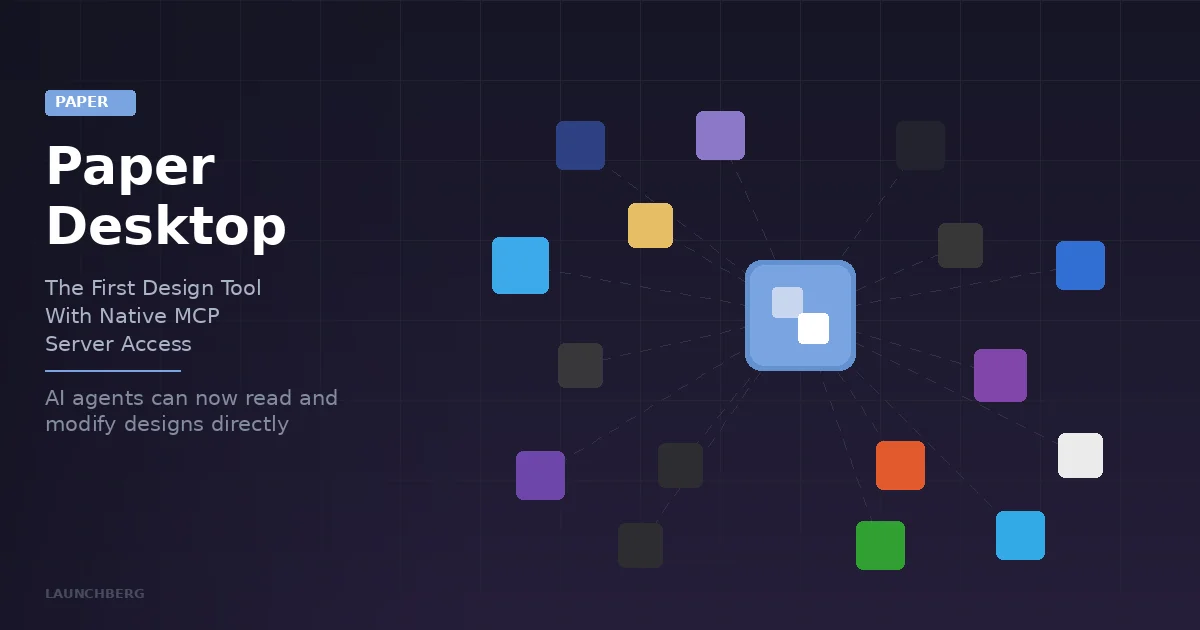
Most design tools added AI as a feature. Paper built a design tool where AI agents are the workflow.
Paper Desktop, launched March 10 in open alpha, is a macOS app that connects your design canvas directly to AI agents, code repositories, and team collaboration — all built on web standards. The headline capability: MCP (Model Context Protocol) server support baked in from day one, meaning any MCP-compatible AI agent can read, modify, and create design elements on your canvas without you switching tools.
MCP Changes What "AI-Assisted Design" Means
The MCP integration is the part that matters. When Paper says "agents," it doesn't mean a chatbot that generates a mockup from a prompt. It means Claude, GPT, or any agent that speaks MCP can connect to your running Paper instance and manipulate the actual design file — moving elements, updating text, adjusting layouts, syncing tokens with code.
The free tier gives you 100 MCP tool calls per week. Pro ($16/user/month) bumps that to 1 million per week — enough for agents to run continuously during a design sprint without hitting limits.
This is a fundamentally different model from how Figma or Sketch approach AI. Those tools treat AI as a feature inside the application. Paper treats the design canvas as a resource that external agents can access, the same way a codebase is a resource that Claude Code Review or Codex can access.
Design to Code and Back
Paper's pitch is "the connected canvas" — and the March 10 update makes that concrete. Agents can sync design tokens, styles, and components between your codebase and your canvas. One source of truth, always current. Change a color variable in code, it updates on the canvas. Adjust a component's padding in Paper, the agent writes it back to your repo.
For teams already using design tokens (and in 2026, that's most teams at companies like Vercel, Perplexity, Zed, Tailwind CSS, and Replicate — all listed as production users), this closes the gap that's existed since design tools and code editors became separate categories.
What's Actually New in the March 10 Build
Beyond MCP support and the desktop app itself, the update is substantial:
A new Constraints panel controls how child elements behave when their parent gets resized — think responsive layout rules defined visually. Backdrop filters landed in the Filters panel, letting you blur or adjust what's behind an element without touching the element itself. OpenType font features are now exposed in the text details panel, which means ligatures, stylistic alternates, and tabular numbers are accessible without writing CSS.
The file dashboard got a redesign with search and view options. Multiplayer cursor logic improved. The code export got cleaned up — fewer redundant styles, proper position: relative handling, and correct shadow/filter compositing.
How It Compares
| Feature | Paper | Figma |
|---|---|---|
| MCP agent access | Native, 100/week free | No |
| Design-to-code sync | Bidirectional via agents | Dev Mode (one-way) |
| Pricing | Free / $16 Pro | Free / $15 Pro / $25 Org |
| Desktop app | macOS (alpha) | macOS, Windows |
| Built on | Web standards | WebGL + C++ (WASM) |
| Open alpha | Yes | No |
Who This Is For Right Now
Paper is in open alpha, which means it's usable but incomplete. The customer list — Vercel, Perplexity, Zed, dub, Tailwind CSS, Replicate, Attio, Daylight, Quartr — skews heavily toward developer-tool companies and startups that already live in the agent ecosystem. These are teams where the designer and the developer are often the same person, or at least sit close enough to share a design token file.
If you're at an enterprise running Figma with 200 seats and a mature design system, Paper isn't replacing that workflow tomorrow. But if you're at a 10-person startup where an AI agent already writes half your frontend code and you want that agent to also update the designs? Paper is the first tool that actually makes that possible — not as a demo, but as a daily workflow with real multiplayer, real code export, and real agent access to the design file itself.